Deterrence
A person decides the property looks inconvenient or uncertain and moves on.

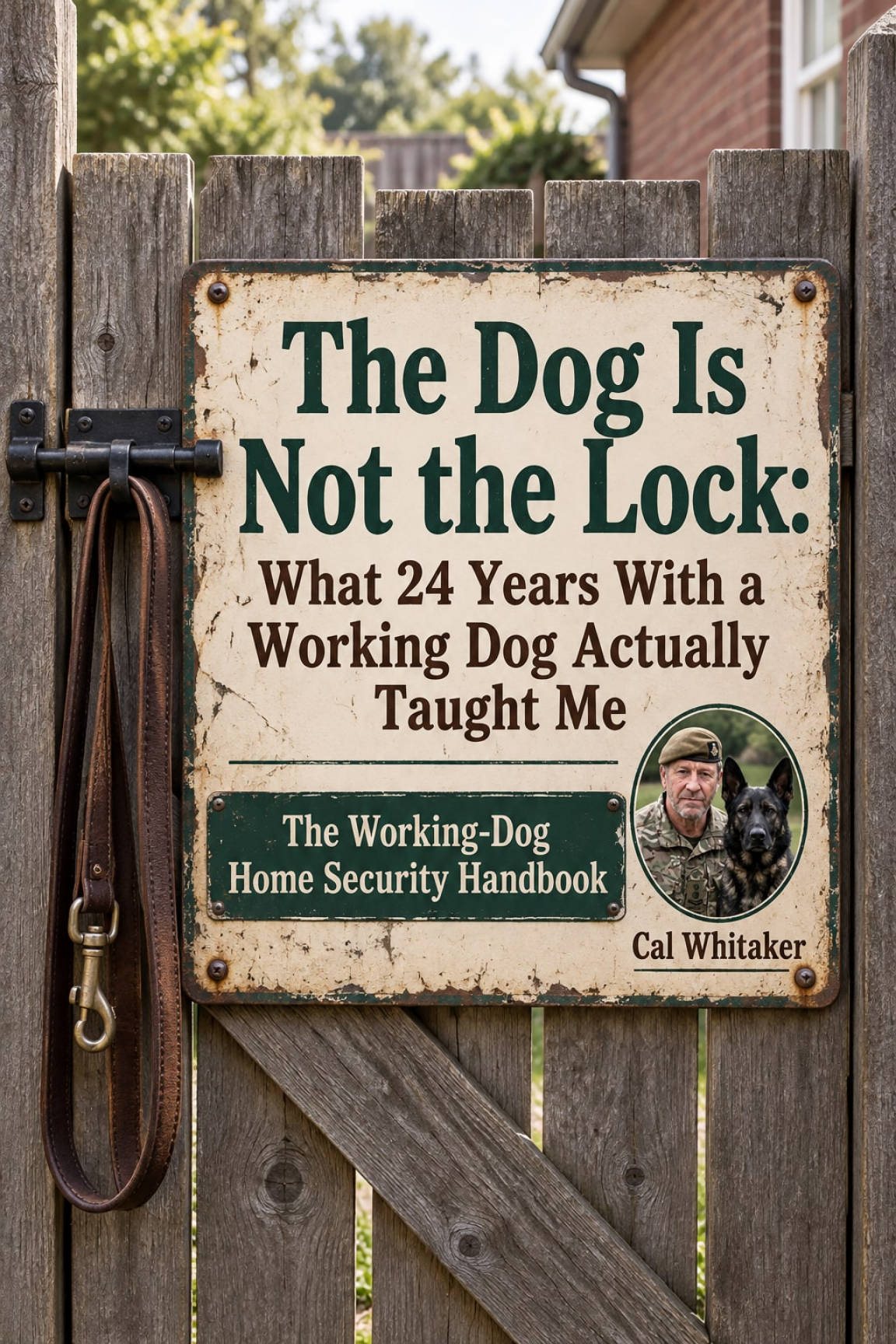
The Working-Dog Home Security Handbook
Make your home harder to read without asking your dog to be a weapon.
A precise, practical handbook from 24-year K9 veteran Cal Whitaker.
The actual security problem
A dog may buy roughly ninety seconds of noise, uncertainty, and warning. That interval can matter, but only when the person inside already has a plan.
Deterrence, detection, delay, and physical intervention are different jobs. Treating them as one job produces a dangerous assumption: that the dog will know what is happening, choose the right response, and stop an intruder without harming a resident, visitor, neighbor, or itself.
Meanwhile, the ordinary signals around a home keep speaking. A rigid arrival time suggests when the house is empty. One lamp used every evening suggests one occupied room. Deliveries, bins, gate habits, repeated dog walks, and conversations at the door can reveal that a person lives alone.
The dog contributes signals too. Fence behavior can show whether anyone inside is paying attention. A fixed walking routine exposes schedule. Poor leash control tells a stranger how much physical authority the handler actually has.
The consequence is simple: buying a larger dog does not repair an easily read household. It may add handling risk while leaving the locks, lighting, communication, gate discipline, retreat plan, and exit route unchanged.
The useful question is not, “Will my dog stop someone?”
It is, “What will I do while my dog is telling me that something has changed?”
Instant PDF access. Read anywhere or print your own copy.
A person decides the property looks inconvenient or uncertain and moves on.
The dog or resident notices a change early enough to make a decision.
Locks, distance, barriers, and confusion slow access while the resident acts.
Physical confrontation carries consequences that ordinary family dogs should not be asked to absorb.

What is inside
Each section separates what a dog can realistically contribute from the work that must be done by the property and the person inside.
Know where to move, whom to call, what to say, and which door not to approach while the dog is making noise.
Read posture, attention, scenting, movement, recovery, fear, excitement, and reactions the household may have reinforced by accident.
Check the gate, fence, side yard, bins, vehicles, and concealed approaches without searching for a fight or turning the routine into theater.
Use recurring observations from accounts collected from roughly four hundred burglars without confusing those observations with guarantees.
Change fifteen revealing habits involving arrivals, lights, deliveries, bins, doorway conversations, and dog-walking schedules.
Identify the three signals a repeated routine may expose: your schedule, your handling strength, and whether the household is attentive.
Evaluate leash control, surprise, stairs, visitors, veterinary handling, injury, recovery, and emergency evacuation before size becomes a liability.
Understand why two manageable small dogs may provide overlapping awareness—and when added cost or training load makes that the wrong choice.
Look at arousal, recovery, bite capacity, exercise demand, genetic variation, handling margin, and the consequences of one bad day.
Review each candidate by useful trait, likely nuisance, mobility, handling needs, sourcing, and individual temperament.
Record reactions to recurring vehicles, scent trails, changed gates, and new human patterns without treating every bark as proof of surveillance.
Coordinate locks, lighting, sight lines, phones, trusted contacts, deliveries, an interior retreat, and an exit plan.
Interior page previews
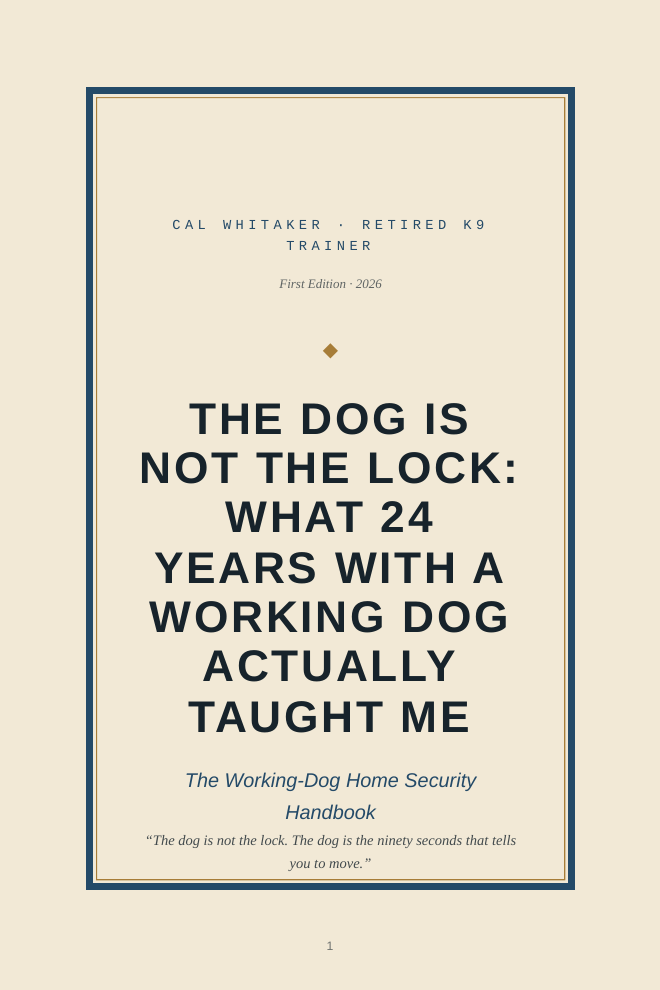
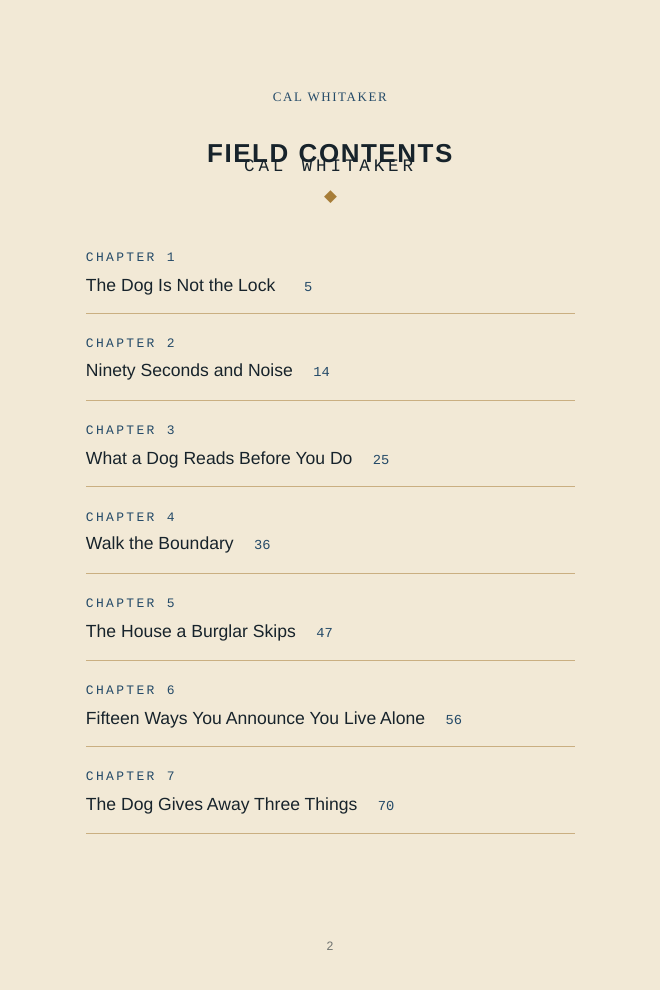
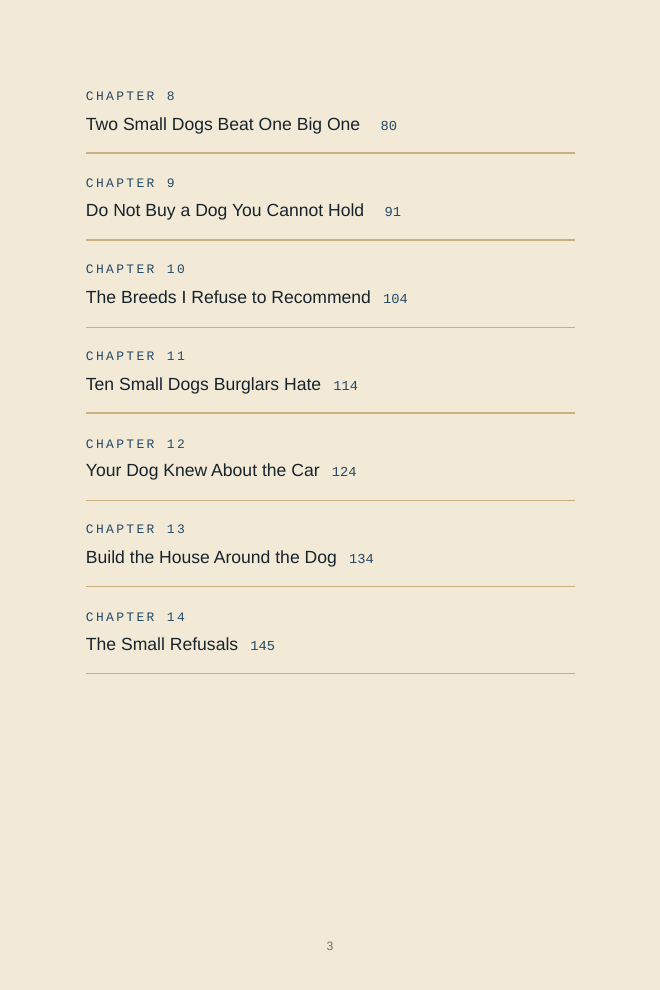
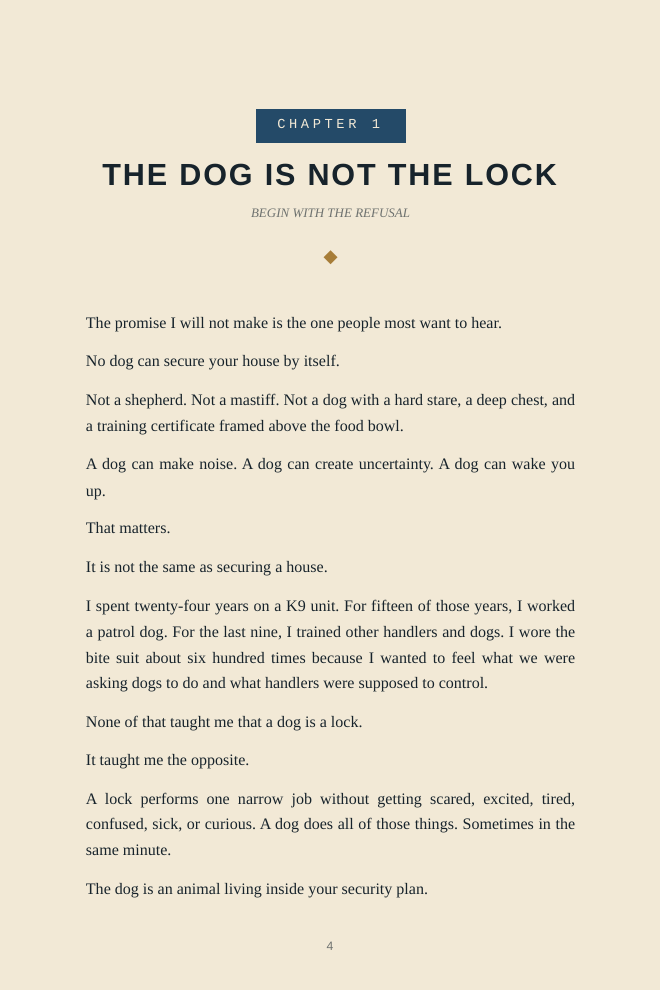
The edition contains 159 pages across fourteen practical chapters. These sample pages show the finished interior and reading format.
Introducing the book
A plainspoken home-security handbook about what dogs notice, what strangers can read, and why the safest selection rule is physical: do not buy a dog you cannot hold.
This book exists because protection demonstrations and short online videos collapse several different ideas into one dramatic image: a large dog moving toward a threat. That image leaves out the handler, the property, the visitor who entered unexpectedly, the veterinary emergency, the unsecured gate, and the resident who cannot physically recover the dog after surprise.
Cal Whitaker wrote down the system he now uses at home after twenty-four years on a K9 unit. The dog notices the ordinary rhythm of the property. The resident checks changes without escalating them. Doors and gates delay access. Lighting removes concealment. Phones and trusted contacts provide communication. A retreat and exit plan decide where the resident goes next.
| Question | Protection fantasy | This handbook |
|---|---|---|
| What is the dog's job? | Confront and stop a person. | Notice change, create noise, and buy decision time. |
| What makes a dog suitable? | Size, appearance, confidence, or breed reputation. | Manageability, recovery, temperament, health, and physical handler margin. |
| What secures the house? | The animal itself. | Locks, gates, lighting, communication, habits, retreat, and exit planning. |
| What happens during a warning? | The resident waits to see what the dog does. | The resident follows a short, preselected response plan. |
The complete offer
The point is not to make your home feel militarized. It is to make your household less predictable, improve early warning, and give each security layer one clear job.
You receive the complete First Edition as a PDF immediately after purchase. It can be read on a phone, tablet, or computer, and you may print a copy for your own use.
Free lifetime updates are included. If Cal adds or revises material in future editions, your access remains current without another purchase.
This book is not for everyone
If you want a guarantee that a dog will stop a burglar, a recommendation for unmanaged aggression, or a breed chosen primarily for intimidation, this is not your book.
It is for readers willing to give the dog a limited role and make the doors, gate, lighting, phone, household routine, and emergency plan carry the rest.
The guarantee
Security advice should reduce uncertainty by giving you actions you can actually perform. It should not leave you with a larger animal and the same unanswered questions.
Open the book. Review the ninety-second response plan, the boundary walk, the fifteen revealing habits, the physical hold test, and the low-cost household layers.
If the handbook is not useful to your situation, request a refund within seven days. The goal is a practical plan, not a reluctant purchase.
Includes free lifetime updates.
Frequently asked questions
The handbook avoids guarantees and breed mythology. These are the objections it is designed to address directly.
No. The book often argues against placing high-drive working or guarding breeds in ordinary homes. Its central rule is that a resident should not buy a dog they cannot physically hold, manage during surprise, assist when injured, or evacuate in an emergency.
No dog guarantees protection, and the book will not claim otherwise. It discusses useful traits, handling risk, individual temperament, and ten small-dog candidates, but it assigns the main security work to the house and the resident.
Yes. The chapters on warning, baseline behavior, boundaries, visible routines, leash control, visitors, gates, retreat planning, and layered security still apply. The aim is not to condemn your dog. It is to place realistic limits around its role.
Yes. The book includes guidance for apartments, rental restrictions, shared approaches, regular visitors, mobility limits, and situations where permanent property modifications are not possible. Many recommendations concern routine, communication, lighting, delivery habits, and controlled access.
No. It does not teach bite work, attack commands, or physical confrontation. Cal's position is that a family dog should not be asked to stand between a resident and violence. The dog's safer contribution is detection, noise, uncertainty, and warning.
You receive a 159-page PDF with fourteen chapters. Access is provided immediately after purchase. You can read it on common digital devices or print a copy for your own use. Free lifetime updates and a seven-day refund period are included.
The final rule
Let the dog notice. Let the locks delay. Let the lighting remove concealment. Let the phone, retreat plan, and exit route give you somewhere useful to go.
Make the household harder to read without making the dog responsible for violence.
159 pages · Instant PDF access · 7-day refund · Lifetime updates
One useful rule to keep
Apply that rule to the leash, stairs, visitors, veterinary handling, injury, surprise, and evacuation—then build the rest of the security plan around the dog.
Get instant access — $19.99159-page PDF with a 7-day refund period and free lifetime updates.